
Global Trends and Projections of Fall-Related Mortality Among Older Adults, 1990–2040: Addressing the Silent Killer in Aging Societies
This study presents a global, systematic analysis of fall-related mortality trends from 1990 to 2021 across 59 high-income and upper-middle-income countries, with further projections extending to 2040. Using official mortality registry data from the World Health Organization (WHO), which ensure high consistency and cross-national comparability, this study is the first to utilize this authoritative database for a comprehensive, long-term global analysis of fall-related mortality.
The findings reveal that global fall-related mortality rates declined markedly by 52.54% from 1990 to 2009, but subsequently rebounded by 13.53% by 2021. This upward trend was particularly pronounced among older age groups. Notably, individuals aged 85 years and older experienced a substantial rise in fall-related mortality over the past three decades, underscoring the growing challenges faced by rapidly aging and super-aged societies.
Subgroup analyses revealed that higher fall-related mortality rates were consistently observed among males, residents of high-income countries, and older adults. Moreover, cross-country variations in mortality were closely linked to differences in social development, income inequality, and environmental conditions, underscoring the critical influence of structural determinants on health outcomes.
Model-based projections suggest that, without effective intervention, global fall-related mortality rates will continue to rise through 2040. Although some regions have experienced declines in mortality rates, the absolute number of fall-related deaths is expected to increase steadily due to population growth and accelerated population aging.
In conclusion, this study highlights fall-related mortality as a mounting yet often overlooked threat—a ‘silent killer’—in aging societies, emphasizing the urgent need for proactive, age-specific, and population-tailored prevention strategies to reduce mortality risks and alleviate future burdens on public health and healthcare systems. This work has been published in the internationally renowned journal The Lancet Healthy Longevity (Kim S, et al., Lancet Healthy Longev. 2025 Jan;6(1):100672).
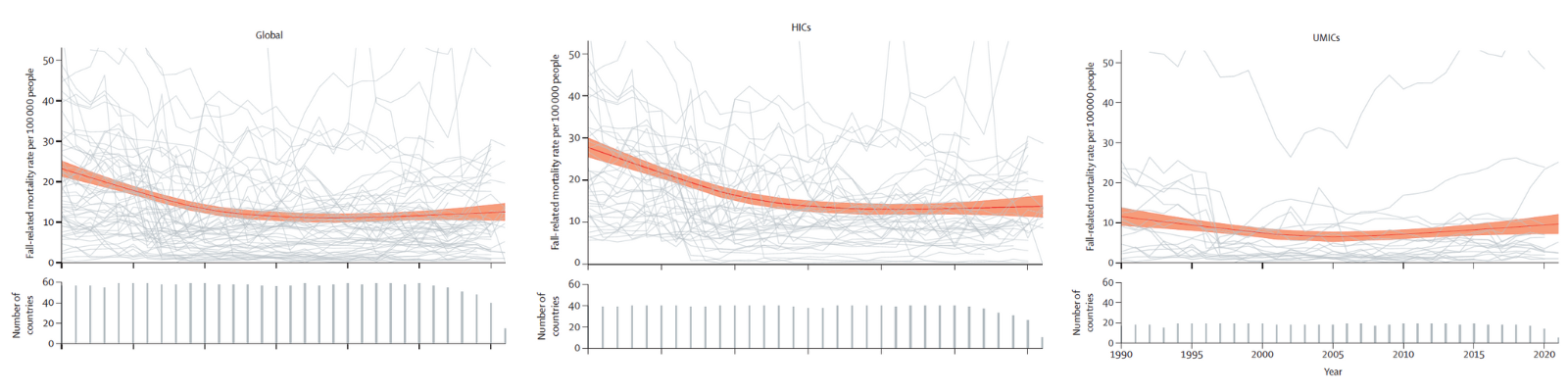
Figure, Age-standardised temporal trends in fall-related mortality from 1990 to 2021 in the global population, high-income countries (HICs), and upper-middle-income countries (UMICs).
The figure shows a global pattern of declining fall-related mortality rates after 1990, followed by a subsequent rebound in recent years. Although overall trends are similar between high-income and upper-middle-income countries, the magnitude of decline and rebound differs, reflecting long-term variations in fall-related mortality risk across economic strata.
