
Establishing Age- and Sex-Specific Reference Standards for Muscle Health in Asian Populations: A Multinational Cohort Study
Accurately identifying when muscle health begins to decline across the aging trajectory is critical for promoting healthy aging and enabling early interventions. However, Asia has long lacked large-scale, population-based normative data spanning diverse ethnic groups and age ranges, limiting the availability of robust and representative reference standards for clinical risk assessment and public health decision-making.
To address this critical gap, this study integrated data from eight cohort studies across three Asian countries, encompassing 34,265 adults, to construct the largest and most comprehensive muscle health reference database for Asian populations to date. This represents a landmark contribution to geriatric medicine, epidemiological research, and sarcopenia science. Using regression modeling and percentile estimation, the study established age- and sex-specific normative curves for five key muscle health indicators: handgrip strength, appendicular skeletal muscle mass, calf circumference, five-repetition chair stand time, and walking speed. The analysis identified critical inflection points where muscle function begins to decline across the aging trajectory.
The findings revealed distinct, sex-specific age-related trajectories in muscle health among Asian populations. In men, handgrip strength began declining in the early 40s, while walking speed showed accelerated decline after age 50. In contrast, Asian women maintained relatively stable appendicular skeletal muscle mass until approximately age 80. These findings reveal substantial differences in muscle aging trajectories between Asian and Western populations, suggesting that cultural factors, lifestyle patterns, and socioeconomic environments may shape patterns of muscle decline.
This study not only addresses a critical gap in age-spanning normative data for muscle health in Asian populations, but also provides reference standards directly applicable to clinical diagnosis and community-based screening. These findings establish a robust scientific foundation for developing predictive models of muscle decline, designing precision prevention strategies, and informing evidence-based health policies for aging populations. This work has been published in the Journal of Cachexia, Sarcopenia and Muscle (Chen LK, et al., J Cachexia Sarcopenia Muscle. 2025 Feb;16(1):e13731).
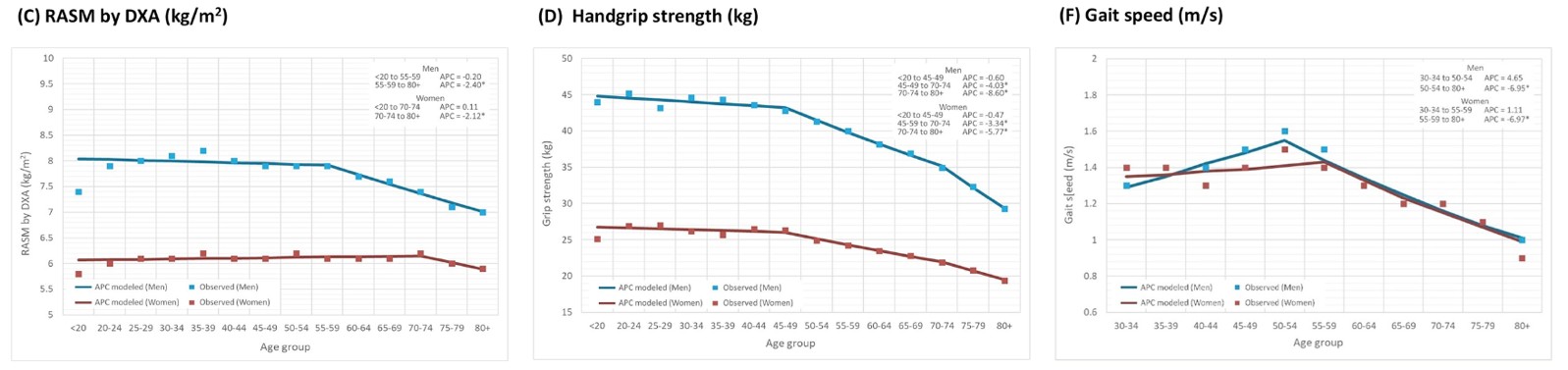
Figure, Age- and sex-specific trajectories of appendicular skeletal muscle mass, handgrip strength, and walking speed in Asian populations. Men demonstrate pronounced declines in multiple indicators beginning in midlife, whereas women exhibit more gradual changes across most measures.
