
Long-Term Statin Use and Muscle Health in Middle-Aged and Older Adults: Evidence from a 20-Year Japanese Cohort Study
This study utilized up to 20 years of longitudinal data from the National Institute for Longevity Sciences–Longitudinal Study of Aging (NILS-LSA), a well-established Japanese cohort, to evaluate the association between long-term statin use and sarcopenia-related outcomes among community-dwelling adults aged 40 years and older.
Statins are first-line agents for managing hyperlipidemia and rank among the most commonly prescribed long-term medications in middle-aged and older adults. Although short-term adverse muscle effects, such as myalgia, have been well-documented, evidence on the long-term impact of statin use on muscle health and sarcopenia risk in aging populations remains limited and inconclusive. Previous studies have been constrained by insufficient follow-up duration, incomplete assessment of muscle parameters, and inadequate control for indication bias and time-varying confounders.
To address these critical gaps, this study employed a rigorous pharmacoepidemiological design. Propensity score matching combined with risk-set sampling ensured comparability between statin users and non-users. Cox proportional hazards models with time-varying covariates were then applied to account for dynamic changes in exposure status and confounders throughout the extended follow-up period. Outcomes were defined according to the 2019 Asian Working Group for Sarcopenia (AWGS) consensus and included incident sarcopenia, changes in muscle mass, muscle strength, and walking speed.
The findings revealed no significant associations between long-term statin use and incident sarcopenia, muscle mass decline, loss of muscle strength, or impaired physical performance. These findings remained robust across age- and sex-stratified subgroup analyses and multiple sensitivity analyses, including propensity score overlap weighting, active comparator designs, and negative control outcomes. Collectively, these results demonstrate high robustness and support the conclusion that long-term statin use does not adversely affect muscle health in middle-aged and older adults.
This study addresses long-standing clinical concerns regarding potential adverse effects of statins on muscle health in aging populations while demonstrating the critical importance of rigorous pharmacoepidemiological design and advanced statistical methods in evaluating long-term medication safety. This work has been published in the Journal of Cachexia, Sarcopenia and Muscle (Huang ST, et al., J Cachexia Sarcopenia Muscle. 2025 Feb;16(1):e13660).
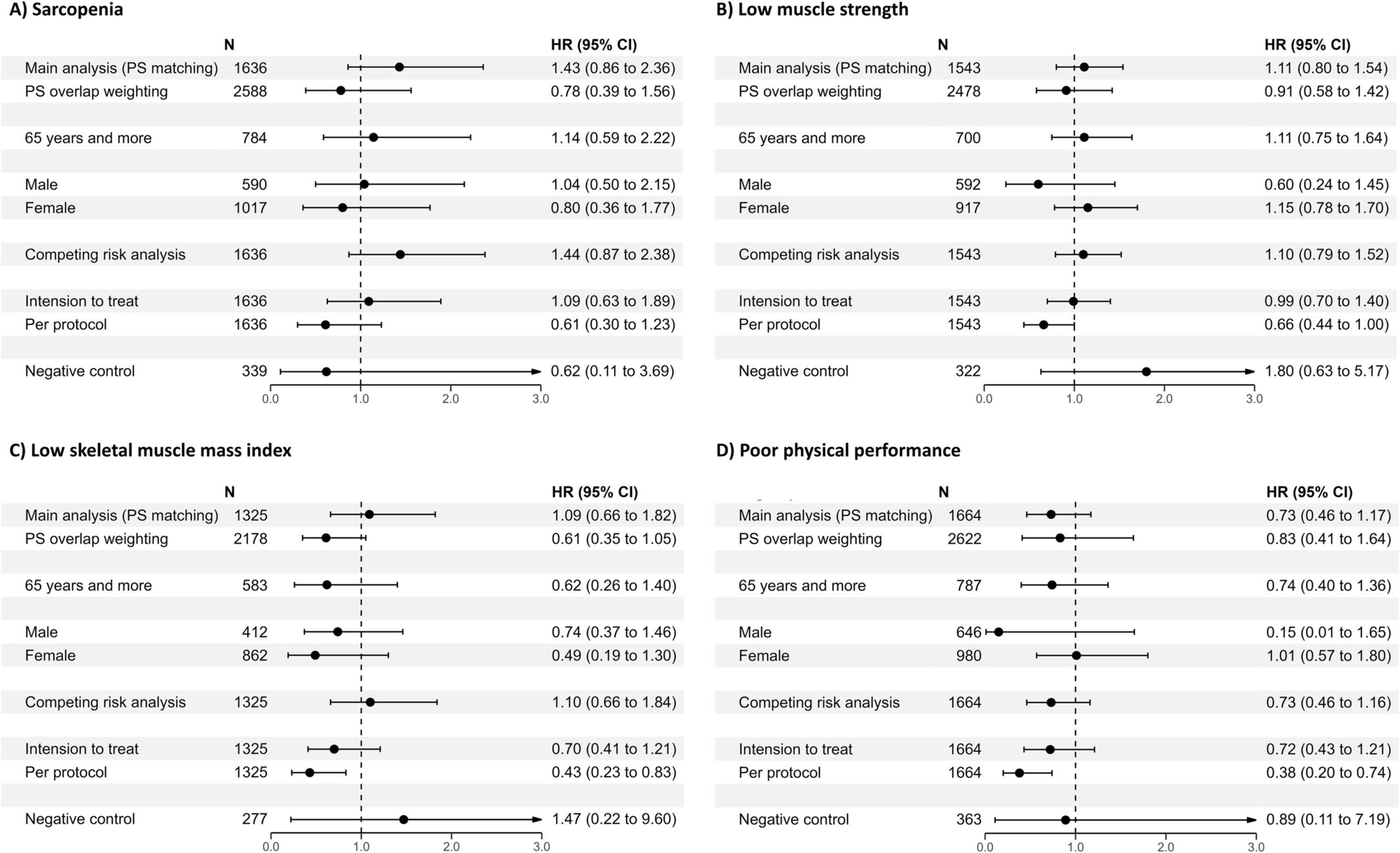
Figure, Forest plots illustrating sensitivity analyses for primary and secondary outcomes. Results demonstrate the robustness of null associations between long-term statin use and sarcopenia-related endpoints across multiple analytical approaches.
