
Frailty-Stratified Precision Care for Older Adults with Diabetes and COPD: A Nationwide Population-Based Study in Taiwan
This landmark study utilized Taiwan’s nationwide National Health Insurance Research Database to address a common yet clinically complex comorbidity in aging populations—diabetes mellitus with chronic obstructive pulmonary disease (COPD). This study represents the first global analysis to incorporate frailty stratification into the evaluation of pharmacological treatment effectiveness among older adults with diabetes and COPD.
The findings demonstrated that sodium–glucose cotransporter 2 (SGLT2) inhibitors provide substantial cross-organ protective benefits in real-world clinical practice. Compared with dipeptidyl peptidase-4 (DPP-4) inhibitors, SGLT2 inhibitors significantly reduced hospitalization risks for pulmonary complications (including pneumonia and acute COPD exacerbations) and decreased all-cause mortality by 40% (HR 0.60).
This Taiwan-based real-world evidence confirms that both SGLT2 inhibitors and glucagon-like peptide-1 (GLP-1) receptor agonists confer significant pulmonary protective effects in older adults with diabetes and COPD. Importantly, these findings provide critical evidence for frailty-informed, individualized precision prescribing strategies in this vulnerable population. This work has been published in eClinicalMedicine (Meng LC, et al., eClinicalMedicine. 2025 July;85:103332).
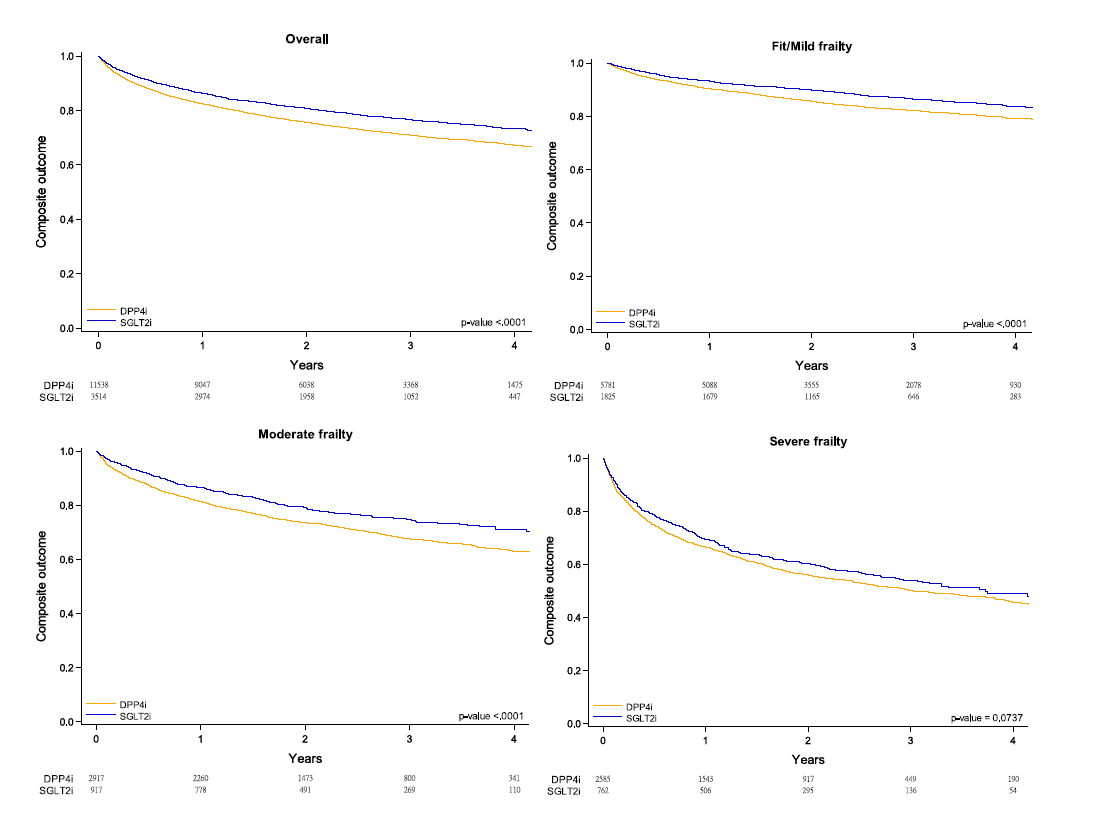
Figure, Survival analysis of composite pulmonary events across different frailty strata. Given the strong associations among acute pulmonary events, frailty, and mortality risk in older adults with diabetes and multimorbidity, comparing medication effects across frailty strata directly addresses key clinical needs in precision diabetes care.
